
PPM stands for “parts per million,” a unit that measures tiny amounts of something dissolved in water.
You have seen it on pool test kits, water filter boxes, and TDS meter screens. It looks technical, but the idea behind it is surprisingly simple.
This guide breaks down the ppm meaning in plain words, shows where you will meet it in daily life, and clears up the mix-ups people always make.
Quick Answer
The most common ppm meaning is “parts per million,” a unit for measuring tiny concentrations in water. In water, 1 ppm equals 1 milligram per liter, and it shows up on pool kits, filters, and TDS meters.
What Does PPM Stand For?
PPM means “parts per million.” It tells you how many parts of a substance exist inside a million parts of a mixture.
In plain words: imagine a million tiny drops of water. If one of those drops is chlorine, the water has 1 ppm of chlorine. That is the whole idea.
Scientists and water pros use it because percentages are too clumsy for tiny amounts. Saying “0.0001 percent” is awkward, while “1 ppm” is clean and clear.
The unit works for anything dissolved or mixed in: minerals in drinking water, chlorine in pools, salt in a fish tank, or pollutants in a river.
The Simple Math Behind PPM
For water, the math is friendly. One liter of water weighs about one kilogram, which is one million milligrams.
So 1 ppm equals 1 milligram per liter, written as 1 mg/L. A TDS meter reading of 200 ppm means 200 milligrams of dissolved stuff in every liter.
This is why water reports flip between the two. “150 ppm” and “150 mg/L” describe the exact same water.
Where You Meet PPM in Everyday Life
PPM is not locked in a lab. It pops up in ordinary places, usually wherever water quality matters.
| Where You See It | What It Measures | Typical Reading |
|---|---|---|
| Swimming pool test kit | Free chlorine | 1 to 3 ppm |
| Home TDS meter | Total dissolved solids | 50 to 500 ppm |
| RO filter product page | How much the filter removes | “Reduces TDS by up to 95%” |
| Fish tank strip | Nitrates, pH-related minerals | Varies by species |
| City water quality report | Contaminants and minerals | Listed per substance |
Pools
Pool owners live by PPM. Test strips show chlorine, pH balancers, and stabilizer levels, all in ppm. Too little chlorine and the water turns green. Too much and eyes start burning.
The sweet spot for free chlorine sits between 1 and 3 ppm. That tiny range keeps the water safe without the harsh chemical smell.
Drinking Water
That number on your TDS meter is a ppm reading. It counts everything dissolved: calcium, magnesium, sodium, and other minerals.
Tap water often lands between 100 and 400 ppm. RO filtered water drops much lower, sometimes under 50 ppm, which is why it tastes so light.
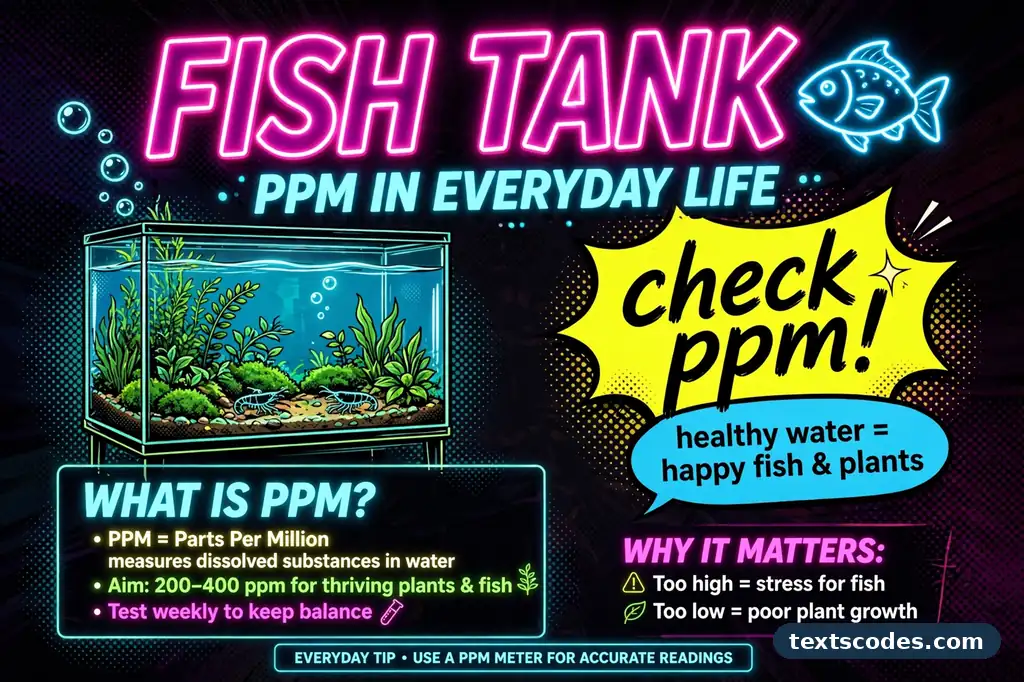
Fish Tanks and Plants
Aquarium keepers test nitrates in ppm to keep fish healthy. Gardeners check nutrient solutions the same way. In both hobbies, the right ppm range is the difference between thriving and struggling.
PPM vs PPB vs Percent: The Comparison
PPM has two smaller siblings. Once you see all three side by side, the scale finally makes sense.
| Unit | Stands For | Equals in Water | Think Of It As |
|---|---|---|---|
| Percent (%) | Parts per hundred | 10,000 mg/L | A slice of a pie |
| PPM | Parts per million | 1 mg/L | A drop in a bathtub |
| PPB | Parts per billion | 1 microgram/L | A drop in a swimming pool |
The ladder is simple: 1 percent equals 10,000 ppm, and 1 ppm equals 1,000 ppb. Each step down is a thousand times smaller.
Regulators use ppb for the scary stuff, like lead and arsenic, because dangerous levels are far below 1 ppm. PPM handles everyday minerals and treatment chemicals.
PPM in Texting and Chat
Yes, ppm shows up in chats too, just not as slang. It appears in practical conversations about water, pools, and filters.
Someone might text a photo of their TDS meter reading “320 ppm” and ask if their filter is working.
A pool group chat might debate whether 4 ppm chlorine is too high for kids.
In aquarium and gardening communities, “what’s your ppm?” is a normal question. It asks for a nutrient or nitrate reading, the same way a gamer asks about FPS.
Elsewhere, ppm can mean pages per minute in printing or procs per minute in gaming. Context tells you which one is meant.
If a friend texts “ppm?” with zero context, they are probably asking about a water reading you both discussed, or they typed an abbreviation you will need to ask about.
Common Misunderstandings About PPM
- Thinking PPM means percent. It does not. One percent is 10,000 ppm, so mixing them up throws every number off by a mile.
- Assuming a small number means harmless. Some substances are dangerous below 1 ppm, which is why lead limits are set in ppb.
- Believing lower TDS is always better. Ultra-low TDS water tastes flat, and some minerals in water are perfectly fine.
- Reading one ppm number as a full water report. A TDS reading tells you the total, not which substances make it up.
- Expecting ppm to mean the same thing everywhere. In printing it is pages per minute, in gaming it is procs per minute, so check the context.
How to Read PPM Numbers Like a Pro
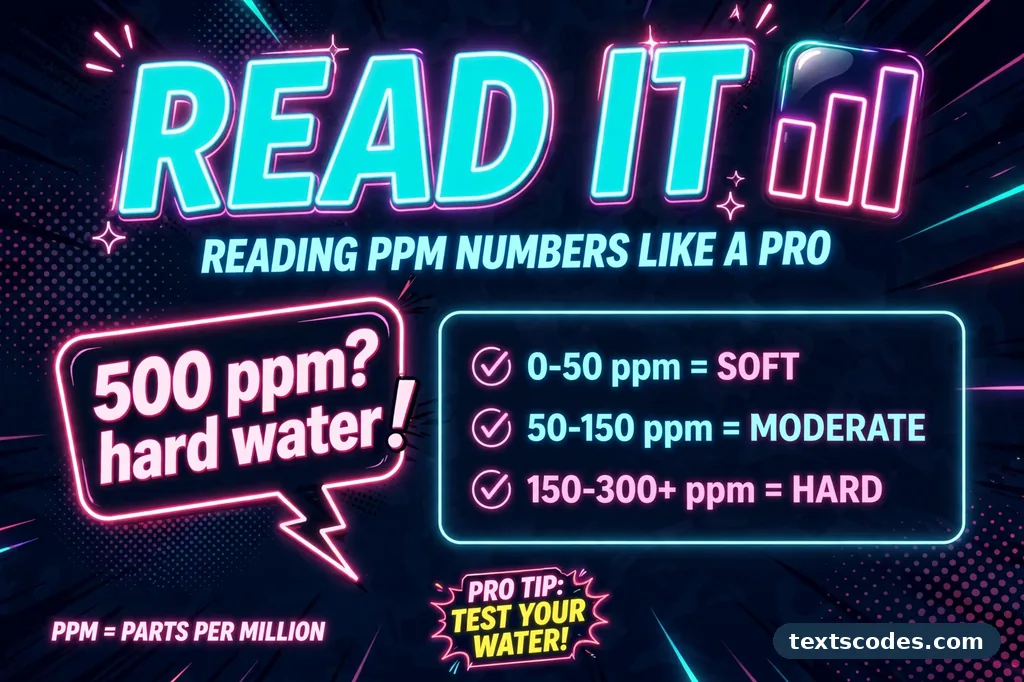
Numbers only help when you know the range. Here are the everyday benchmarks people actually use.
For drinking water, the US EPA sets a secondary guideline of 500 ppm for total dissolved solids.
Above that, water may taste salty or metallic. Note it is a taste guideline, not a hard health limit.
Many people find water between 50 and 150 ppm tastes the best: clean but not empty. Bottled mineral water often sits in this zone on purpose.
For pools, free chlorine should stay between 1 and 3 ppm. Test weekly in summer, since heat and sunlight burn chlorine off faster than yuo expect.
FAQs About PPM Meaning
What does PPM mean in simple words?
It means “parts per million.” It measures how much of something is mixed into a much larger amount, like milligrams of minerals in a liter of water.
Is higher PPM always bad?
No. It depends on what is being measured. High mineral ppm can be fine, while even low ppm of something toxic is dangerous. The substance matters more than the number.
How is PPM calculated?
In water, 1 ppm equals 1 milligram per liter. A liter of water weighs about one million milligrams.
Labs measure the dissolved substance and divide by the water volume to recieve an accurate reading.
What is a safe PPM level for drinking water?
The EPA suggests keeping total dissolved solids under 500 ppm for good taste. For individual contaminants like lead, the safe limits are far lower and measured in ppb.
Is PPM the same as mg/L?
In water, yes. Because of water’s density, 1 ppm and 1 mg/L describe the same concentration. In air or soil, the conversion works differently.
Why do pool test kits use PPM?
Because pool chemicals work in tiny doses. Measuring chlorine in ppm keeps the numbers readable: 2 ppm is clearer than 0.0002 percent, and small errors are easier to spot.
Conclusion
PPM is just a tidy way to talk about tiny amounts. “Parts per million” sounds technical, but it really means counting small pieces inside a very large whole.
In daily life you will meet it most in water: pool chlorine, TDS meters, filter specs, and city reports. Now those numbers actually mean something when you see them.