
IMA means I am going to. It is a short, casual way to say you plan to do something, and it shows up in texts, comments, and chats all day long.
You have probably read it in a message like “ima call you later” and understood it at once, even if you never stopped to think about the spelling.
Below, you will find the full meaning, where it came from, real chat examples, the tone behind it, and smart replies you can use when someone sends it to you.
Quick Answer
The ima meaning is simple: IMA stands for I am going to. People use it in casual texts and social media chats to announce a plan, an intention, or something they are about to do, usually without writing out the full sentence.
What Does IMA Mean in Text?
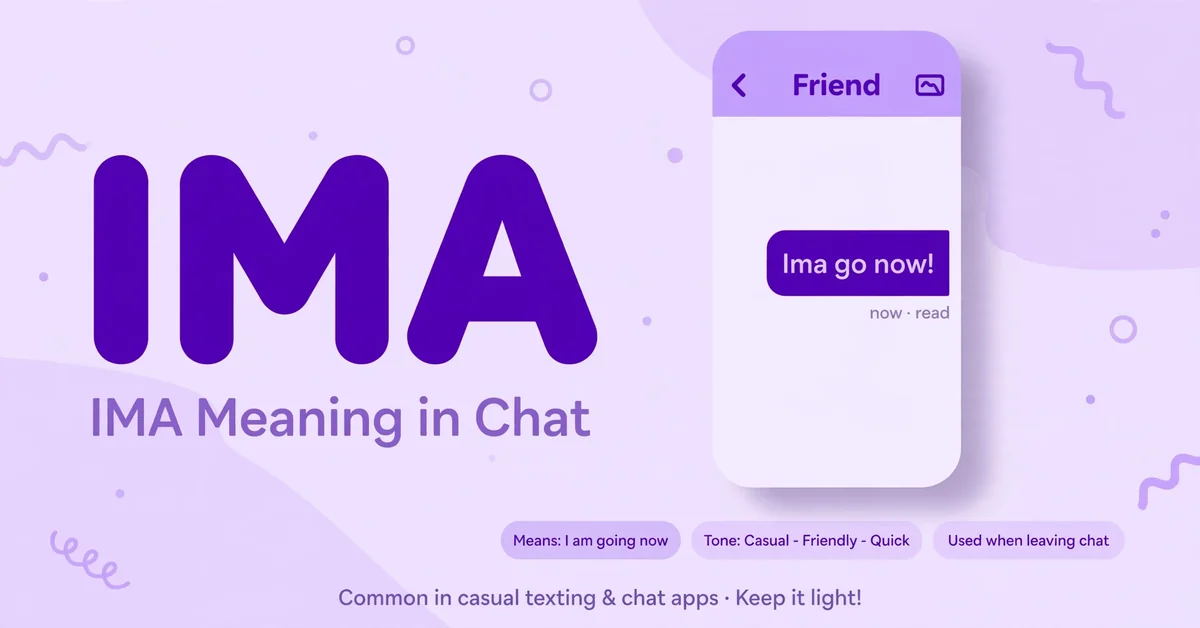
In texting, IMA works as a shortcut for a whole plan. When someone writes “ima grab lunch,” they are really saying I am going to grab lunch, just in a faster, more relaxed form.
It almost always sits before a verb. You will see it before words like call, sleep, watch, leave, and eat, because it sets up the action that follows.
Here is the simple breakdown:
- I = I
- M = am
- A = going to
Put together, it reads as “I am going to.” Like ISTG, it packs a full thought into a tiny package, which is why it fits so well in fast chats.
Where Did IMA Come From?
IMA grew out of speech, not a textbook. Its root is spoken “I’m gonna”, said so often in real talk that the shortened spelling started to feel natural in writing too.
Early texting helped it spread, since short messages were quicker to send and recieve. From phones, it moved to WhatsApp, Instagram, TikTok comments, Discord, and gaming chats.
It survived because it sounds like how people actually talk. Other casual shortcuts from the same world, like GNG, followed the same path from speech to screen.
IMA in Real Chats
Reading examples is the fastest way to get IMA, because timing changes the feel of the message. Here are chats you might actually see:
Evening plan: “What are you doing tonight?” Reply: “ima watch a movie and chill.”
Work message: “Did you send the file?” Reply: “Not yet, ima send it in five minutes.”
Friend check in: “Are you coming to the party?” Reply: “Yeah, ima be there around eight.”
Tired reply: “You look exhausted.” Reply: “I know, ima sleep early tonight.”
Notice how each reply answers a question and also tells you what happens next. That forward look is the whole point of IMA.
What IMA Really Signals
Behind the three letters, IMA usually signals a plan already in motion. The person is not just thinking about an action, they have decided to do it.
Sometimes it signals closeness. Friends use it with each other because it sounds relaxed, warm, and unforced, like speech rather than a formal note.
It can also signal urgency when a time word follows it. “Ima leave now” feels immediate, while “ima do it later” feels loose. Chat slang like HN works the same way: tiny words, big clues about tone.
IMA vs IMMA and Other Short Replies
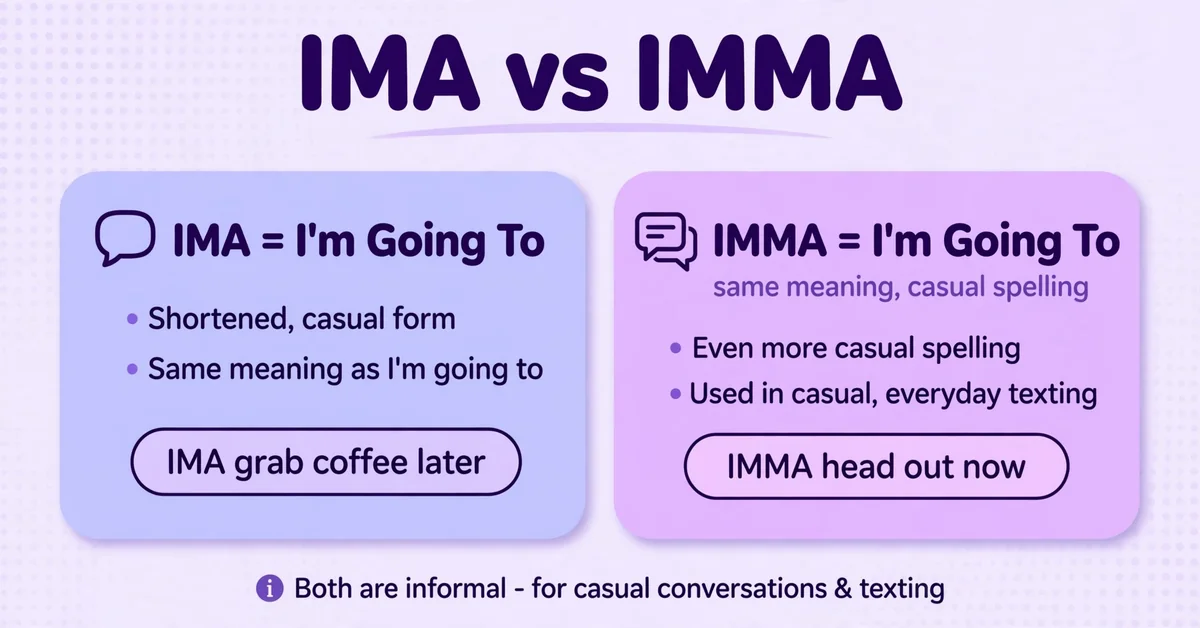
People mix IMA up with lookalike replies, but each one does a different job. The key point is that IMA and IMMA mean the same thing, while the other terms below do not.
| Term | Meaning | Tone | When to use it |
|---|---|---|---|
| IMA | I am going to | Casual | Announcing a plan |
| IMMA | I am going to | Casual | Same use, different spelling |
| Gonna | Going to | Relaxed | Informal speech and texts |
| IDK | I do not know | Neutral | You lack the answer |
| BRB | Be right back | Brief | Stepping away for a moment |
The big mix up is IMA versus IDK. IDK means you do not know something. IMA means you know exactly what you plan to do next.
Common IMA Variations
People stretch IMA by adding a small word after it. Each version adds a shade of timing or attitude, and ima rn is the one you will see most often.
- Ima rn: means “I am going to right now.”
- Ima later: pushes the plan to a later time.
- Ima lol: keeps the plan light and funny.
- Ima fr: stresses that the plan is serious.
- Ima just: makes the action sound simple or quick.
- Ima head out: means leaving right away.
As a rule, the extra word tells you when or how serious the plan is. A seperate time word, like “later” or “tomorrow,” is often the most useful clue in the whole message.
How to Reply When Someone Sends IMA
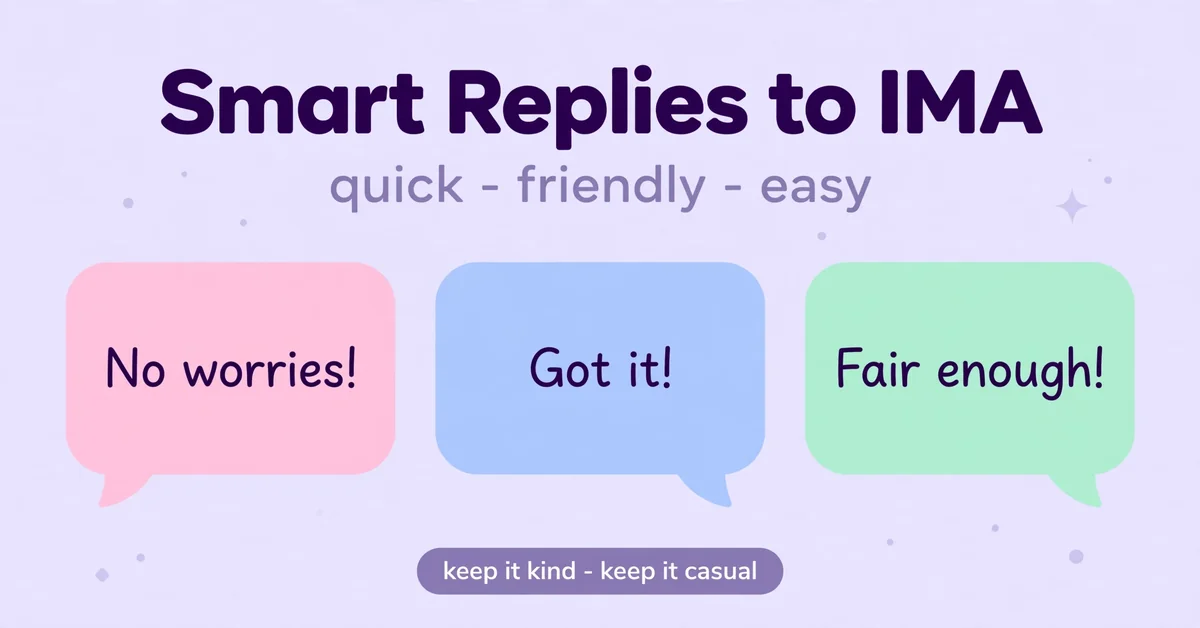
The best reply is one that matches their energy. If they sound excited, sound excited back. If they sound tired, keep it gentle.
Easy replies: “Sounds good!”, “Okay, cool”, “Let me know how it goes.”
Funny replies: “Ima hold you to that”, “About time”, “Finally, a plan.”
Warm replies: “Take your time”, “Have fun”, “Text me when you are done.”
Do not overthink it. IMA is a low pressure message, so a short, friendly reply usually fits better than a long one.
When Not to Use IMA
Skip IMA in formal messages. In a job email, a school assignment, or a message to someone you barely know, the full phrase “I am going to” reads far more clearly.
Also avoid it when the plan needs to be exact. If timing, money, or safety depends on your words, write the full plan out instead of hiding it in slang. Short forms like SN belong in casual chats, not in serious ones, and IMA follows the same rule.
FAQs
Is IMA rude?
No, IMA is not rude by itself. It is casual, not disrespectful, though it can feel dismissive if the moment calls for a careful reply.
What does IMA mean in text?
It means “I am going to.” People use it to announce a plan or an action they are about to take.
Is IMA the same as IMMA?
Yes, in most chats they mean the same thing. IMMA is simply a longer spelling of the same spoken phrase.
Can I use IMA at work?
Better not to. It reads as informal in a professional chat, so write the full sentence instead.
Is IMA still used today?
Yes, it is still common in texting, social media comments, and gaming chats, mostly among younger users and frequent texters.
Final Thoughts
IMA is a tiny word with a simple job: it tells people what you are about to do, without slowing the chat down. Once you know it means “I am going to,” you will spot it everywhere.
Use it with friends, in casual chats, and when the plan is clear. In formal moments, spell it out. In the end, reading the moment is what makes any slang land well.