
Introduction
The English language contains thousands of words, and even simple words can sometimes create confusion. One common example is begining. Many people use this spelling when writing messages, preparing assignments, creating articles, or communicating professionally. Although it looks correct at first glance, there is an important spelling detail that every English learner should understand.
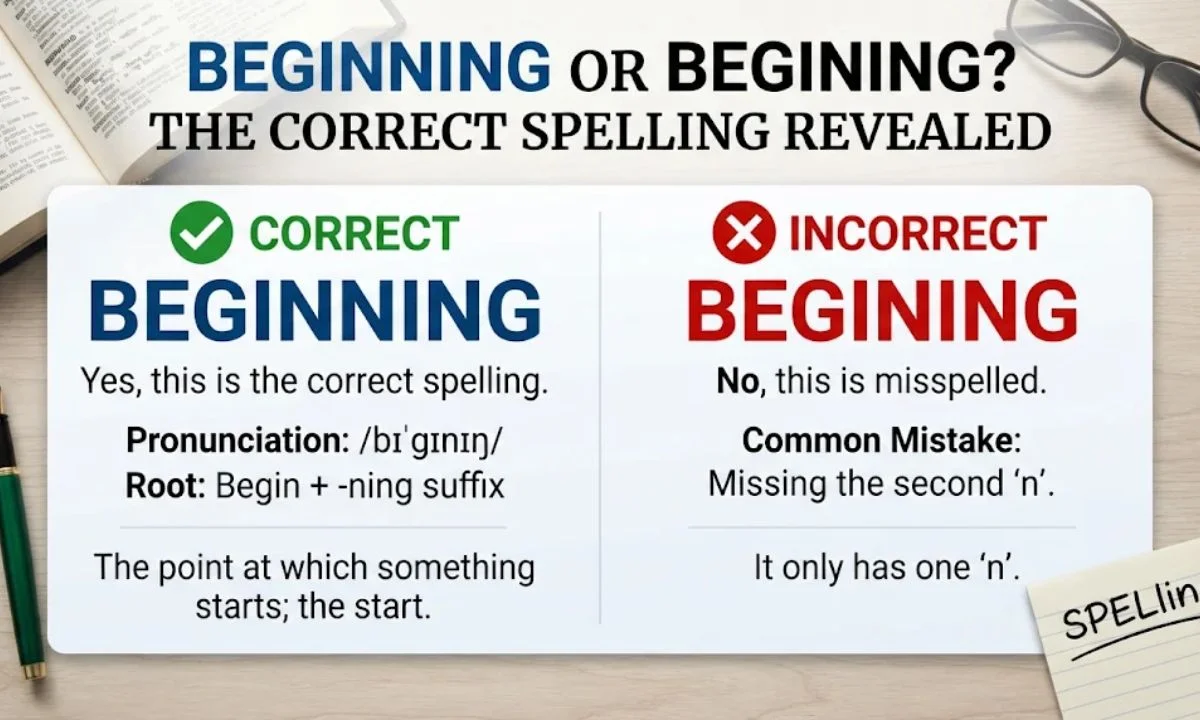
The word begining is a common misspelling of the word beginning. The correct spelling contains two n’s in the middle, making it slightly different from what many people expect. This small difference can affect the quality of written communication, especially in professional documents, academic assignments, and online content.
Understanding the meaning, spelling, pronunciation, and usage of beginning can help writers avoid unnecessary mistakes. Whether someone is learning English, improving their vocabulary, or simply trying to write more accurately, knowing the difference between begining and beginning is useful.
This article explores the meaning of begining, explains why people commonly misspell it, provides practical examples, and shares helpful techniques for remembering the correct spelling.
What Does Begining Mean?
The word begining is generally intended to represent the word beginning. However, begining is not the standard English spelling and is considered incorrect in formal writing.
The correct word, beginning, refers to the start or first part of something. It can describe the starting point of an event, activity, journey, process, relationship, or experience.
For example, when someone says, “The beginning of the movie was exciting,” they are talking about the opening part of the movie.
Similarly, the sentence “Every successful journey has a beginning” explains that every achievement starts somewhere.
The word beginning can also describe the process of starting something. For example, “She is beginning a new career” means that she is starting a new professional journey.
Although people frequently search for begining, writers should use beginning whenever they want to communicate this meaning correctly.
Begining vs. Beginning: What Is the Difference?
The main difference between begining and beginning is spelling.
Begining contains one n after the letter i, while beginning contains two consecutive n’s in the middle.
| Word | Status | Explanation |
|---|---|---|
| Begining | Incorrect | Common spelling mistake |
| Beginning | Correct | Standard English spelling |
The correct spelling follows an important English spelling rule. When a short verb ends in a consonant-vowel-consonant pattern and receives an ending such as -ing, the final consonant is often doubled.
The original verb is begin. When the suffix -ing is added, the final consonant n is doubled.
Therefore:
- Begin + ing = Beginning
- Run + ing = Running
- Sit + ing = Sitting
- Swim + ing = Swimming
This pattern explains why beginning contains two n’s rather than one.
Why Do People Commonly Spell Beginning as Begining?
There are several reasons why people write begining instead of beginning. Most of these mistakes happen because English spelling does not always follow predictable patterns.
1. Confusion About Double Consonants
One of the biggest reasons is uncertainty about when to double a consonant.
English learners often understand that the suffix -ing is added to verbs, but they may not remember that certain verbs require an additional consonant before the suffix.
For example, someone might correctly write walking and talking but mistakenly write begining.
Learning the spelling pattern can help prevent this error.
2. Pronunciation and Spelling Differences
English pronunciation does not always make spelling obvious. The word beginning is pronounced with a natural flow, and the doubled n does not necessarily sound like two separate letters.
As a result, people may write the word according to how they think it sounds rather than how it is actually spelled.
3. Fast Typing
Another common reason is typing too quickly.
When people write social media posts, text messages, emails, or website content, they sometimes overlook small spelling errors.
The word begining is particularly easy to type because it looks similar to the correct spelling.
4. Limited Knowledge of English Grammar
Some people have not studied consonant-doubling rules in detail. Without understanding how suffixes affect spelling, it becomes easier to make mistakes when changing verbs into different grammatical forms.
Learning a few basic spelling rules can significantly improve writing accuracy.
The Meaning of Beginning in Different Contexts
The word beginning has several uses in everyday English. Understanding these contexts makes it easier to use the word naturally.
Beginning as the Start of Something
The most common meaning of beginning is the starting point of an event, activity, or experience.
Examples include:
- The beginning of the school year is always exciting.
- We enjoyed the beginning of the concert.
- The beginning of the story introduces the main characters.
- Every friendship has a beginning.
In these examples, beginning refers to the first stage of something.
Beginning as an Action
Beginning can also function as the present participle of the verb begin.
For example:
- She is beginning her new job tomorrow.
- They are beginning a difficult project.
- The students are beginning their examination preparations.
- I am beginning to understand the lesson.
In these sentences, beginning describes an action that is starting or developing.
Beginning in Education
The word is also commonly used in educational settings.
For example, a beginning English course is designed for people who are just starting to learn the language.
Other expressions include:
- Beginning mathematics
- Beginning computer science
- Beginning writing skills
- Beginning photography
These phrases generally describe introductory levels of learning.
Beginning in Personal Development
In motivational writing, beginning often represents an opportunity for change.
People use expressions such as “a fresh beginning” or “a new beginning” when describing a positive change in their lives.
For example, someone starting a new business, entering university, or moving to another city might describe the experience as a new beginning.
Correct Examples of Beginning in Sentences
Learning through examples is one of the easiest ways to remember the correct spelling.
Here are some sentences demonstrating how beginning can be used:
- The beginning of the book immediately captured my attention.
- Every great achievement has a beginning.
- She is beginning to feel more confident.
- We are beginning a new chapter in our lives.
- The beginning of the movie was full of surprises.
- He made several mistakes at the beginning of his career.
- The teacher explained the beginning of the lesson.
- A new beginning can create exciting opportunities.
- They are beginning their journey next week.
- The beginning of the year is a good time to set goals.
Notice that the spelling remains the same in every example, regardless of whether the word refers to a starting point or an action.
Common Expressions That Use Beginning
The word beginning appears in many familiar English expressions. These expressions are useful in conversations, articles, professional writing, and everyday communication.
A New Beginning
This expression describes a fresh start or an opportunity to make positive changes.
Example: “Moving to another country gave him a new beginning.”
From the Beginning
This phrase means from the very start of something.
Example: “I knew the answer from the beginning.”
At the Beginning
This expression identifies the first part of a particular period, event, or activity.
Example: “At the beginning of the meeting, everyone introduced themselves.”
In the Beginning
This phrase refers to an initial period or the earliest stage of something.
Example: “In the beginning, learning a new language seemed difficult.”
Beginning to Understand
This expression means gradually starting to understand something.
Example: “I am beginning to understand how this software works.”
Learning these expressions can help English learners develop more natural communication skills.
How to Remember the Correct Spelling
Remembering the difference between begining and beginning does not have to be difficult. A few simple techniques can make the correct spelling easier to remember.
Remember the Original Verb
Start with the word begin. When adding -ing, double the final n.
Begin + ing = Beginning.
Repeating this simple formula can help you remember the spelling whenever you write the word.
Practice Similar Words
Learning other words that follow the same consonant-doubling pattern can strengthen your spelling skills.
Examples include:
- Run becomes running.
- Sit becomes sitting.
- Swim becomes swimming.
- Stop becomes stopping.
- Plan becomes planning.
Practicing these words helps you recognize similar spelling patterns.
Read More English Content
Reading books, newspapers, educational materials, and reliable websites exposes you to correct spelling.
When you repeatedly see beginning written correctly, your memory gradually becomes more familiar with its standard form.
Use Spell-Checking Tools
Modern word processors and writing applications often identify spelling mistakes automatically.
If you type begining, a spell-checking tool may suggest beginning as the correction.
However, it is still important to understand the rule instead of depending entirely on technology.
Write Your Own Sentences
Create five or ten sentences using beginning. This exercise helps reinforce both spelling and meaning.
For example, write about the beginning of your day, the beginning of a new project, or the beginning of a personal goal.
Regular practice makes correct spelling feel more natural.
Synonyms of Beginning
Several English words have meanings similar to beginning. These alternatives can make writing more interesting and reduce repetition.
Common synonyms include:
- Start
- Commencement
- Introduction
- Opening
- Origin
- Launch
- Outset
- Foundation
- Inception
- First stage
Although these words are related, they are not always interchangeable.
For example, commencement is often associated with formal events, while launch is commonly used when discussing products, businesses, or projects.
Similarly, origin usually refers to where something comes from rather than simply the first moment of an activity.
Choosing the right synonym depends on the sentence and its intended meaning.
Antonyms of Beginning
An antonym is a word that expresses the opposite meaning of another word.
Some common opposites of beginning include:
- Ending
- Conclusion
- Finish
- Completion
- Termination
- Closure
- Final stage
For example, the beginning of a story introduces its events, while the ending brings those events to a close.
Understanding synonyms and antonyms helps expand vocabulary and improves the ability to express ideas clearly.
Is Begining Ever Correct in English?
In standard modern English, begining is considered a spelling error when someone intends to write beginning.
It may appear in usernames, website addresses, informal messages, search queries, or intentionally misspelled text. However, these appearances do not make it a standard English word.
For school assignments, business communication, professional documents, and published articles, beginning is the correct spelling.
If someone uses begining in a sentence, the best approach is usually to replace it with beginning.
For example:
Incorrect: “The begining of the journey was difficult.”
Correct: “The beginning of the journey was difficult.”
This simple correction makes the sentence grammatically and orthographically appropriate.
The Importance of Correct Spelling in Professional Writing
Correct spelling is an important part of effective communication. Even a small spelling mistake can affect how readers understand or evaluate written content.
In professional environments, spelling mistakes may make emails, reports, presentations, and business documents appear less polished.
For students, accurate spelling is important for assignments, examinations, and academic projects.
For website owners and content creators, proper spelling contributes to readability and a professional user experience.
Search engines can often understand misspelled search queries, but published content should still use standard spelling. Writers should focus on creating useful, accurate, and readable material rather than deliberately repeating incorrect spellings.
Therefore, understanding why begining is incorrect can help writers produce better-quality content across different platforms.
Frequently Asked Questions
1. Is begining the correct spelling?
No. Begining is a common misspelling. The correct spelling is beginning, with two consecutive n’s in the middle.
2. What does begining mean?
People generally use begining when they intend to refer to beginning, which means the start or first stage of something. However, beginning is the standard spelling.
3. Why does beginning have two n’s?
The final consonant of the verb begin is doubled before adding the suffix -ing. This follows a common English spelling rule.
4. What is the difference between begin and beginning?
Begin is the base verb that means to start something. Beginning can refer to the starting point of something or the ongoing action of starting.
For example, “I will begin my work” and “I am beginning my work” are both correct sentences.
5. What are some synonyms for beginning?
Common synonyms include start, opening, commencement, outset, launch, introduction, and inception. The most suitable choice depends on the context.
6. How can I avoid spelling beginning incorrectly?
Remember the formula begin + ing = beginning. Practice similar words such as running, sitting, and swimming to become more familiar with consonant doubling.
7. Can I use begining in an informal message?
People may understand what you mean if you write begining in an informal message. Nevertheless, beginning is always the recommended spelling in standard English.
Conclusion
The keyword begining represents a common spelling mistake that many English writers make when trying to write the word beginning. Although the two forms look almost identical, only beginning is the standard spelling.
The correct word refers to the start of an activity, event, experience, or process. It can also describe the action of starting something, making it useful in countless everyday situations.
The easiest way to remember the spelling is to understand how the original verb changes when the suffix -ing is added. Since begin ends with a consonant-vowel-consonant pattern, its final n is doubled before adding the suffix.
With regular reading, writing practice, and attention to spelling rules, anyone can avoid this common mistake. Whether you are preparing an academic assignment, writing an email, creating website content, or improving your English vocabulary, using beginning correctly will make your communication clearer and more professional.
Every improvement in language skills starts somewhere, and learning even a small spelling rule can be the beginning of better writing.