
IGHT means alright, spelled the way it sounds when the word gets clipped in fast, casual speech.
You have probably stared at a one-word reply and wondered whether it meant yes, maybe, or not really. That tiny word carries more mood than its four letters suggest.
This guide breaks down every job it does, how to say it, how to read its tone, and exactly when to use it or skip it.
Quick Answer
The ight meaning in text is alright, said in a shorthand way. People use it to agree, to show they understood a message, or to say something is fine. Tone, punctuation, and context decide whether it sounds warm, neutral, or dismissive, so read the chat before you judge a reply.
What Does IGHT Mean in Text? 📲
At its core, ight is a casual spelling of alright. It is not a separate word with a secret meaning hiding underneath it.
Most of the time it works as a fast yes. Someone suggests a plan, and “ight” says you are in, you heard them, or you are fine with it.
It can also work as plain acknowledgment with no real enthusiasm attached. That is why the same reply can feel friendly in one chat and flat in another.
Think of it as the shortest version of a nod in a conversation. It confirms, but it does not explain, and it does not add warmth by itself.
Here is the basic range in everyday chats:
Friend: “Meet me at 7.”
You: “ight 👍”
Friend: “Let’s play later tonight.”
You: “ight bet 🔥”
Mom: “Don’t forget to buy milk.”
You: “ight, got it.”
Notice how the added words do most of the emotional work. On its own, “ight” is neutral, and the rest of the message sets the mood.
How Do You Pronounce IGHT? 🗣️
Say it like “eye-t”, rhyming with night. That is the whole trick to the spelling.
The word looks odd on screen because it is written the way it sounds when “alright” gets squeezed in quick speech. The “al” drops away, and what is left is the stressed tail of the word.
Most people say “ight” and “aight” exactly the same way out loud. The difference lives on the keyboard, not in the mouth.
If you say it slowly as “ig-hut” or spell it out letter by letter, you will sound like you have never heard it before. One smooth syllable is all it needs.
In speech it usually lands as a relaxed, falling sound, not a sharp question. Saying it with a rising tone at the end turns it into a check, as in “We good, ight?”
The Different Jobs IGHT Does in a Message 💬
The biggest mistake readers make is assuming ight always means yes. It does four different jobs, and the sentence around it tells you which one it is.
First, it works as a reply. This is the use you will see most often, and it means agreement or acknowledgment, as in answering “Leaving at 8, don’t be late” with a simple “ight.”
Second, it works as an opener. A message that starts “Ight, so here’s the plan” is using it the way other people use “Okay, so” or “Alright, so” to steer into a new subject.
Third, it works as a lukewarm rating. Ask someone how the new pizza place was and they might answer “It was ight.” That is not praise. It means average, forgettable, not worth a second trip.
Fourth, it works as a sign-off. “Ight, talk later” does not mean goodbye in the dictionary sense, but it signals that the chat is wrapping up.
There is also a fifth, smaller job: the tag question. Put it at the end of a sentence, as in “Meet at 8, ight?”, and it asks the other person to confirm.
If you are unsure which job you are looking at, check the structure. A reply answers something, an opener starts something, and a rating describes something.
Here are the five readings side by side:
Maya: “Leaving at 8, don’t be late.” You: “ight.” That is plain acknowledgment.
Jay: “I’m 100% waking up at 6 tomorrow to run.” Sam: “ight, we’ll see 😭” That is a skeptical opener.
Dani: “How was the concert?” Leo: “It was ight, honestly. Sound was bad.” That is a lukewarm rating.
Nia: “Ight, I’m heading out.” That is a sign-off, not a farewell speech.
Kai: “Meet at 8, ight?” That is a confirmation check waiting for your answer.
Origin and History of IGHT 📜
Ight grew out of African American Vernacular English (AAVE), where “alright” was already being clipped in everyday speech.
Linguists call the process elision, which just means leaving sounds out. Say “alright” fast and often enough, and the first syllable wears away.
The chain runs like this: all right becomes aight, and aight gets shortened again to ight. Each step drops a little more of the original word while keeping the meaning intact.
The spellings aight and ight date back to the 1990s in writing, though people were almost certainly saying them well before that. Hip-hop carried them further, and one early landmark is Doug E. Fresh’s 1993 track “I-ight.”
As hip-hop went mainstream in the 2000s, the word travelled with it. It moved from lyrics and TV into chatrooms, forums, and then into texting, where brevity is rewarded.
The 2010s gave it a second life as a meme. The phrase “Ight, imma head out” spread through reaction images and videos, usually attached to a character quietly leaving an awkward situation.
Today it is mainstream internet slang, used far beyond its original community. Its roots still matter, though, because they explain why it sounds relaxed and confident rather than formal or stiff.
Ight, Aight, Aiight: What Is the Difference? 🔤
All three spellings mean the same thing, but they carry slightly different energy. None of them is standard English, so there is no single correct choice.
Ight is the shortest and most texting-native of the three. It looks natural in a quick reply and slightly out of place anywhere formal.
Aight is the older, more spoken form. It feels closer to how the word sounds when someone says it out loud, and it shows up in speech as well as in text.
Aiight stretches the middle of the word for emphasis. It reads as playful or exaggerated, like someone drawing the word out while laughing.
You will also see a’ight and ‘ight with an apostrophe marking the dropped sounds. Those are the same word again, just spelled with the missing letters flagged.
| Spelling | Tone | Where you see it |
|---|---|---|
| Ight | Neutral and casual | Quick texts, DMs, comments |
| Aight | Slightly more drawn out, relaxed | Speech and casual texting |
| Aiight | Exaggerated, often humorous | Jokes, memes, playful chats |
| Alright | Standard, safe for most settings | Everyday writing and speech |
Pick the spelling that matches how you normally type. Switching between them mid-conversation is fine too, since readers treat them as the same word.
Reading the Tone: Punctuation, Caps, and Emojis 🎭
The word itself is neutral, but the details around it set the feeling. One “ight” can sound chill, while another can sound passive or even slightly annoyed.
A period after it can make it feel curt or final, like a door closing. No punctuation at all reads as simple, neutral acknowledgment.
Extra letters stretch the mood in the friendly direction. “Ighttt” sounds playful and enthusiastic, and “Iiiiiight” leans into reluctant agreement, as in okay, fine, you win.
Ellipses pull the other way. “Ight…” sounds hesitant, unsure, or quietly skeptical, so it is a risky reply when someone is waiting for a clear yes.
A question mark turns it into a check. “Ight?” asks whether the other person agrees, and it expects an answer rather than closing the topic.
Capital letters add volume. “IGHT!” reads as hype or strong excitement, while a repeated “ight ight” reads as genuine agreement or a way to end the back and forth.
Emojis work like tone markers when you cannot hear a voice. A laughing face makes it playful, a fire emoji makes it hype, and a thumbs up makes it warm and settled.
After an argument, even a friendly “ight” can sound dismissive, because the conversation before it colours everything after. If you recieve a bare “ight” after sharing something personal, it is worth remembering that short replies leave a lot of room for misreading.
| What you see | How it feels |
|---|---|
| “Ight.” (with a period) | Can feel curt or final |
| “Ight” (no punctuation) | Neutral, simple acknowledgment |
| “Ight!” (exclamation mark) | Enthusiastic, positive, excited |
| “Ight…” (ellipses) | Passive, reluctant, or unsure |
| “Ight?” (question mark) | Asking for confirmation |
| “Ighttt” (extra t’s) | Playful and enthusiastic |
| “IGHT!” (all caps) | Hype, strong excitement |
| “Ight ight” (repeated) | Genuine agreement, or a way to end the back and forth |
Paired with “bet” or “say less”, it reads as confident. Paired with nothing after a serious message, it can read as cold. If you are unsure, match the sender’s energy or add an emoji to soften it.
IGHT on Different Platforms 📱
The core meaning does not change from app to app, but the vibe around it definitely shifts. Each platform has its own pace, and ight bends to fit it.
On TikTok it usually shows up as playful agreement in comments and captions. Someone writes “ight, this dance is stuck in my head” and means they approve, not that they are making plans.
On Snapchat it is a quick, casual reply to a snap. Speed matters there, so a one-word answer feels normal rather than rude.
On Instagram it lands as a laid-back comment or DM confirmation. “Ight, your fit is fire” is praise, and nobody reads it as a cold reply.
On WhatsApp it works more like a plain, friendly okay in family or friend chats. That is also where it can confuse older relatives or anyone who does not follow slang, so a fuller reply is safer there.
On Discord and in gaming chats it is chill acknowledgment between rounds. “Ight, starting the match now” is a green light, not a conversation ender.
On Twitch streams and in comment threads it doubles as a reaction. It says “I saw this, I get it” without stopping the flow of the chat.
| Platform | Usual nuance | Example |
|---|---|---|
| TikTok | Playful agreement in comments and captions | “Ight, this is actually good” |
| Snapchat | Quick, casual reply to a snap | “Ight bet, see you later” |
| Laid-back comment or DM confirmation | “Ight, your fit is fire” | |
| Friendly okay in family or friend chats | “Ight, I’ll bring the snacks” | |
| Discord / gaming | Chill acknowledgment between rounds | “Ight, starting the match now” |
The pattern is simple: on TikTok and Instagram it leans playful, while on WhatsApp and Discord it works more like a plain okay. Context is everything, so always read the conversation before you reply, much like you would with any other short reply such as the ones explained in our YK meaning in text guide.
Common IGHT Phrases 🔥
Ight rarely travels alone. The word after it changes the deal, turning a neutral nod into enthusiasm, acceptance, or a joke.
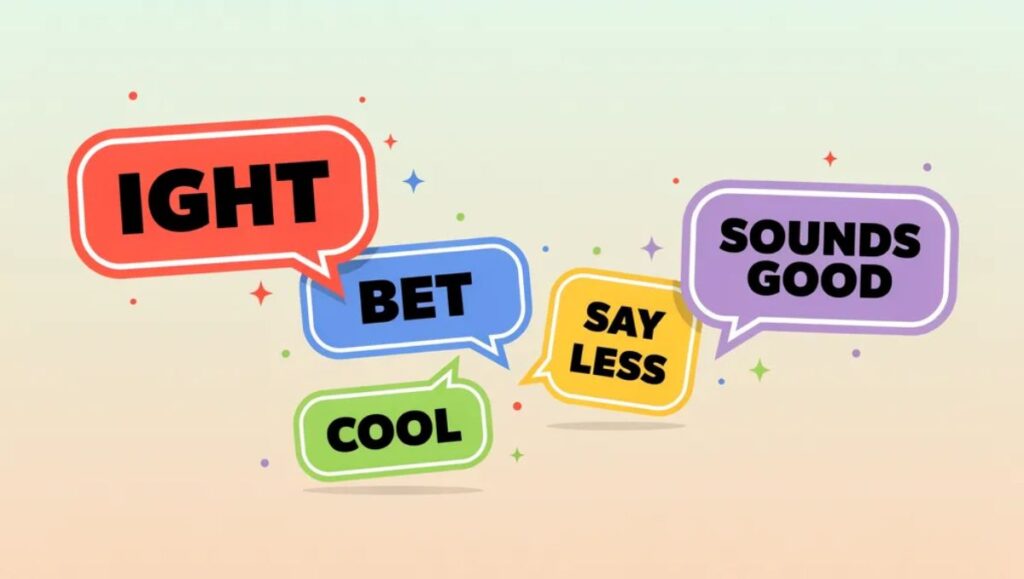
“Ight bet” is the most famous pairing, and it means something like “alright, I’m in” or “okay, sounds good.” It sounds more committed than ight on its own.
But bet can also carry doubt. When someone promises something unlikely and you answer “ight bet”, it can mean “sure, we’ll see”, so the history between you settles which reading is right.
“Ight cool” is relaxed acceptance, the verbal equivalent of a shrug and a nod. “Ight then” accepts what was said and moves on, often closing a small debate.
“Ight say less” means no further explanation is needed. It tells the other person you already understand, so they can stop convincing you.
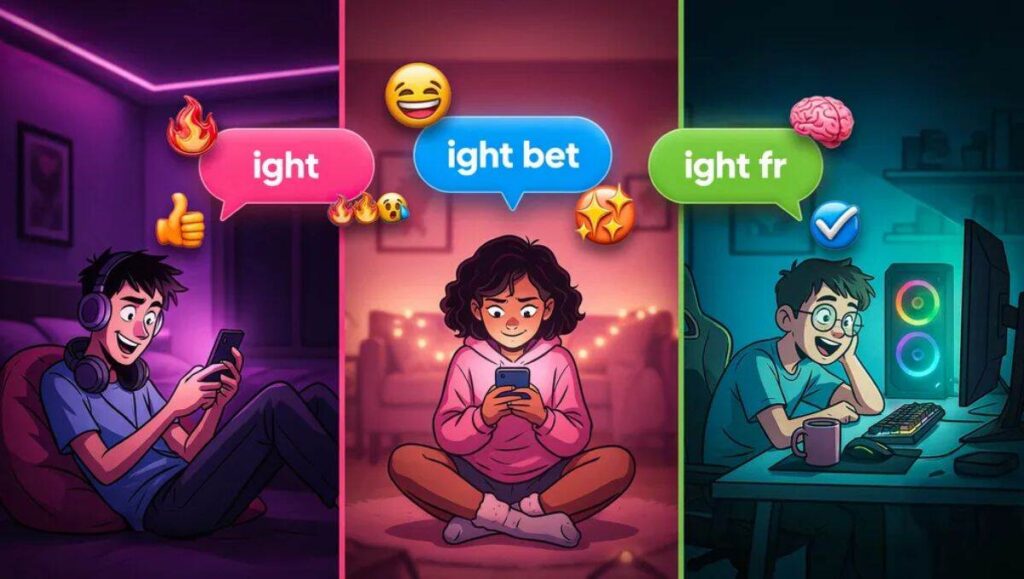
“Ight fr” adds sincerity, as in alright, for real this time. “Ight, imma head out” is the meme version, used when someone is leaving a chat, a room, or an awkward situation.
| Phrase | Meaning |
|---|---|
| Ight bet | Alright, I’m in / sounds good (or sarcastic: we’ll see) |
| Ight cool | Okay, that’s fine |
| Ight bro | Casual acknowledgment between friends |
| Ight then | Acceptance, moving on |
| Ight say less | No further explanation needed |
| Ight fr | Alright, for real |
| Ight, imma head out | Okay, I’m leaving (often a meme exit) |
How to Reply When Someone Says IGHT ⤵️
Start by working out what thier “ight” meant before you answer it. If it was just agreement, you often do not need to answer at all.
If they were confirming plans, a short “Bet 🔥”, “Cool 😎”, or “See you then 👋” keeps the energy up. If they were agreeing with you, “Fr!” or “Exactly 💯” works just as well, and a simple thumbs up emoji does the job too.
Here are a few natural exchanges:
Person A: “ight, I’ll be there.” Person B: “Bet.”
Person A: “ight, I’m heading out.” Person B: “Drive safe 🚗”
Person A: “ight, talk later.” Person B: “Sounds good, catch you tomorrow.”
If the reply felt cold, a direct question beats guessing. “You good?” or “Did that bother you?” clears the air faster than a joke or a matching one-word reply.
With close friends, humour can lighten it instead: “That’s all I get? 😭” But if the topic was serious, skip the joke and use full words.
One short reply is never proof of anything on its own. The pattern across the whole conversation tells you more than any single “ight” ever will, so look at the thread, not just the last message.
When to Use IGHT and When to Skip It ✅❌
Use ight freely with friends, in group chats, and in casual replies where everyone speaks the same slang. It belongs in casual chats only, and that boundary is the whole rule.
Skip it in work messages and emails, in messages to teachers or professors, and in school or academic writing. In those settings it reads as careless even when you mean it warmly.
Skip it in serious or sensitive conversations too. After an apology, bad news, or a disagreement, a one-word reply can look dismissive, and that is the last impression you want to leave.
Skip it when you are unsure the other person knows the slang. Older readers and non-native English speakers may read it as a typo, and then your message fails at its one job, which is to be understood.
Skip it when clarity matters more than speed. If you are confirming a time, a payment, or an important decision, full words remove doubt that slang leaves behind.
A good test is simple: if you would not say “alright” out loud in that situation, do not type “ight” in it either. And if you need a warmer or clearer alternative, the FRFR meaning in text guide shows how emphasis words change a short reply, while our ATP meaning in text guide covers another fast chat shortcut.
Is IGHT an Acronym? Is It a Real Word? 🤔
No, ight is not an acronym. It does not stand for a string of longer words.
People ask “what does ight stand for?” because so much texting slang is made of initials. This one is different: it is a stylized spelling of a spoken word, not a code to decode.
You may see joke expansions online, such as “I Give Hell Tonight” or “I Get Home Tonight.” Those are back-formed guesses or jokes, not real meanings, and nobody uses them in everyday texting.
So is it a real word? Yes, in the sense that dictionaries record it as slang and list aight alongside it. That is a real kind of recognition, just not the standard-English kind.
It is not standard English, so it does not belong in formal writing, exams, or professional documents. Keep it where slang lives, in casual conversation, and switch to “alright” or “okay” everywhere else.
One related point: ight does not mean goodbye. It can show up when someone is ending a chat, but the word itself still means alright, so read it as “okay, we’re done here” rather than as a farewell.
Top Mistakes When Using IGHT ❌
The most common mistake is answering everything with one word. A string of bare “ight” replies starts to sound uninterested, even when you are just busy.
Another mistake is using it right after a serious message. If someone shares something personal and gets “ight” back, the shortness lands harder than the word itself.
A third mistake is using it with people who do not know slang and then wondering why they seem confused. The word only works when both sides share the code.
A fourth mistake is using it in professional emails or schoolwork because it felt natural in a chat. It is easy to copy a habit across contexts, and this is one habit worth keeping fenced in.
The fix for all four is the same: add a few words, match the moment, and save the one-word version for friends who already speak this way. A longer reply costs you two seconds and buys you a lot of goodwill.
Similar Slang and What to Say Instead 🔄
If ight feels too flat for the moment, pick a reply that matches your energy. The alternatives below are not synonyms in every situation, but they cover the same ground with different warmth.
For casual chats, try “bet” when you are committed, “cool” when you are relaxed, “sounds good” when you want warmth, or “gotcha” when you want to stress understanding.
For enthusiastic agreement, go further: “Let’s go!”, “Absolutely!”, “For sure!”, or “Count me in!” These say you are not just okay with a plan, you are excited about it.
For formal settings, drop the slang entirely. “Sounds good”, “Understood”, “Got it”, “Noted”, and “That works for me” all carry the same agreement without the informality.
Mixing these up also keeps your chats fresh. Nobody wants to read “ight” in every single reply, and rotating your responses makes each one feel more genuine, a point that also applies to the short replies in our LYK meaning in text guide.
| Slang | Meaning | How it differs from ight |
|---|---|---|
| Aight | Alright | Same word, older and more spoken spelling |
| Bet | Okay, deal | Warmer and more committed, can turn sarcastic |
| Say less | Understood | Stresses that no more explanation is needed |
| Fr | For real | Adds sincerity rather than agreement |
| Fs | For sure | Stronger certainty than a plain ight |
| K | Okay | Shorter, and often reads as colder |
| Cool | Okay, no problem | More positive and relaxed |
Frequently Asked Questions ❓
Is IGHT the same as AIGHT?
Yes. Aight is simply an older spelling of the same word, and both mean alright.
What does IGHT mean?
It means alright or okay, used to agree, acknowledge a message, or say something is fine.
Is IGHT rude?
Not usually. The word itself is neutral, but a bare one-word reply can sound dry or dismissive depending on tone and timing.
Who uses IGHT the most?
Teenagers, Gen Z users, gamers, and social media users use it most, though anyone in a casual chat can use it naturally.
Can adults use IGHT?
Yes, but mostly in casual conversations. Age matters less than setting, so a relaxed chat with friends is fine and a work email is not.
Is IGHT only used online?
No. Many people say it out loud too, usually pronounced like “aight” in relaxed conversation.
Why is IGHT so popular?
Because it is short, easy to type, and fits modern internet communication. Speed plus a relaxed tone is a combination that travels fast.
What does IGHT BET mean?
It means alright, I’m in, as in okay, sounds good, let’s do it. It can also be sarcastic, so context decides which reading fits.
Is IGHT a real word?
Yes, as slang. Dictionaries record it as informal, but it is not standard English, so keep it out of formal writing.
Does IGHT mean goodbye?
No. It still means alright, even when it shows up at the end of a chat as a sign-off.
Final Thoughts on IGHT ✨
“Ight” may only be four letters, but it is one of the internet’s most useful slang words. Its power is its flexibility, and that flexibility is also its risk.
Whether you are agreeing with friends, confirming plans, ending a conversation, or reacting to content online, “ight” makes communication fast and effortless.
Now whenever someone texts “ight,” you will know they usually mean “alright,” “okay,” or “sounds good.” 😎🔥
Just remember one rule: save it for casual conversations, read the tone before you judge it, and keep it away from professional emails. 😂
Read More Posts…
Want more texting explainers? Try these next: